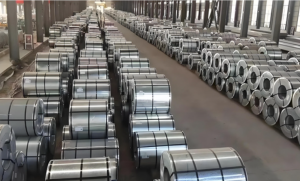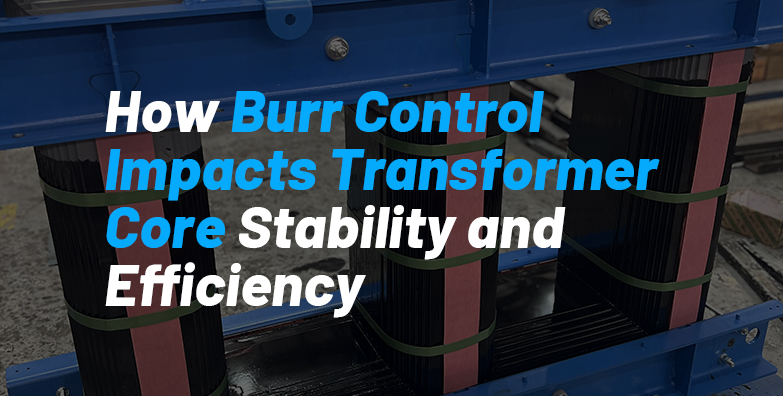
Transformer core stability is not defined by steel grade alone. In practical manufacturing, burr control and edge quality of CRGO laminations directly influence mechanical integrity, magnetic efficiency, acoustic performance, and long-term service life. For this reason, DLS CRGO places strict emphasis on edge finishing standards throughout its slit coil and lamination production process.
Why burrs appear in CRGO processing
Burrs are microscopic raised edges formed during slitting, punching, or shearing of CRGO electrical steel. They typically result from tool wear, improper blade clearance, unstable strip tension, or unsuitable cutting speeds. Even small deviations in these parameters can significantly increase burr height.
Through controlled slitting practices and regular tooling inspection, DLS CRGO maintains stable burr profiles across production batches, ensuring consistent lamination quality.
Mechanical impact on transformer core stability
Poor edge quality disrupts lamination flatness during stacking. Burrs prevent full surface contact between layers, creating uneven pressure zones and internal stress concentrations. Over time, this leads to core movement, reduced clamping force, and increased vibration.
CRGO laminations supplied by DLS CRGO are produced with uniform edge geometry, enabling stable stacking and long-term mechanical reliability of transformer cores.
Magnetic losses and eddy current formation
Burrs may penetrate insulation coatings, causing unintended electrical bridges between laminations. These short-circuited paths increase eddy current losses, raising core loss levels and reducing overall transformer efficiency.
By maintaining clean edges and controlled burr height, DLS CRGO helps preserve insulation integrity and ensure that the designed magnetic circuit remains effective.
Noise and vibration behavior
Edge irregularities and burr-induced gaps disturb magnetic flux distribution inside the core. This irregular flux flow is a common source of transformer humming and vibration.
Uniform edge finishing from DLS CRGO supports smoother flux paths, contributing to quieter transformer operation and improved acoustic performance.
Thermal performance and aging risks
Excess eddy current loss caused by burr-related insulation damage generates localized heating. This accelerates insulation degradation and shortens transformer service life.
Consistent burr control and edge quality management by DLS CRGO support predictable thermal behavior and long-term operational stability.
Accuracy during core assembly
High-quality edge finishing is critical for precise stacking, reliable step-lap formation, and dimensional consistency—especially for mitred and step-lap core structures. Laminations from DLS CRGO enable smoother assembly, reduced handling damage, and stable core geometry throughout installation.
Conclusion
In CRGO transformer cores, burr height and edge quality are decisive parameters influencing core stability, efficiency, noise levels, and service lifetime. Through disciplined slitting control and rigorous inspection standards, DLS CRGO delivers CRGO laminations and slit coils that support reliable transformer performance across diverse applications.